Data centers - potential and planning challenges
Data centers create the conditions for a modern, agile and scalable IT infrastructure in the digital age. However, cloud technologies, Industry 4.0 and the Internet of Things come at a price. They allow data volumes to grow rapidly and have enormous energy requirements.
But precisely because of their high energy requirements, data centers also offer enormous savings potential.
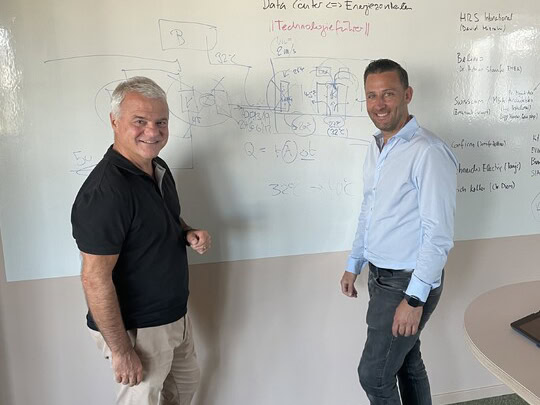
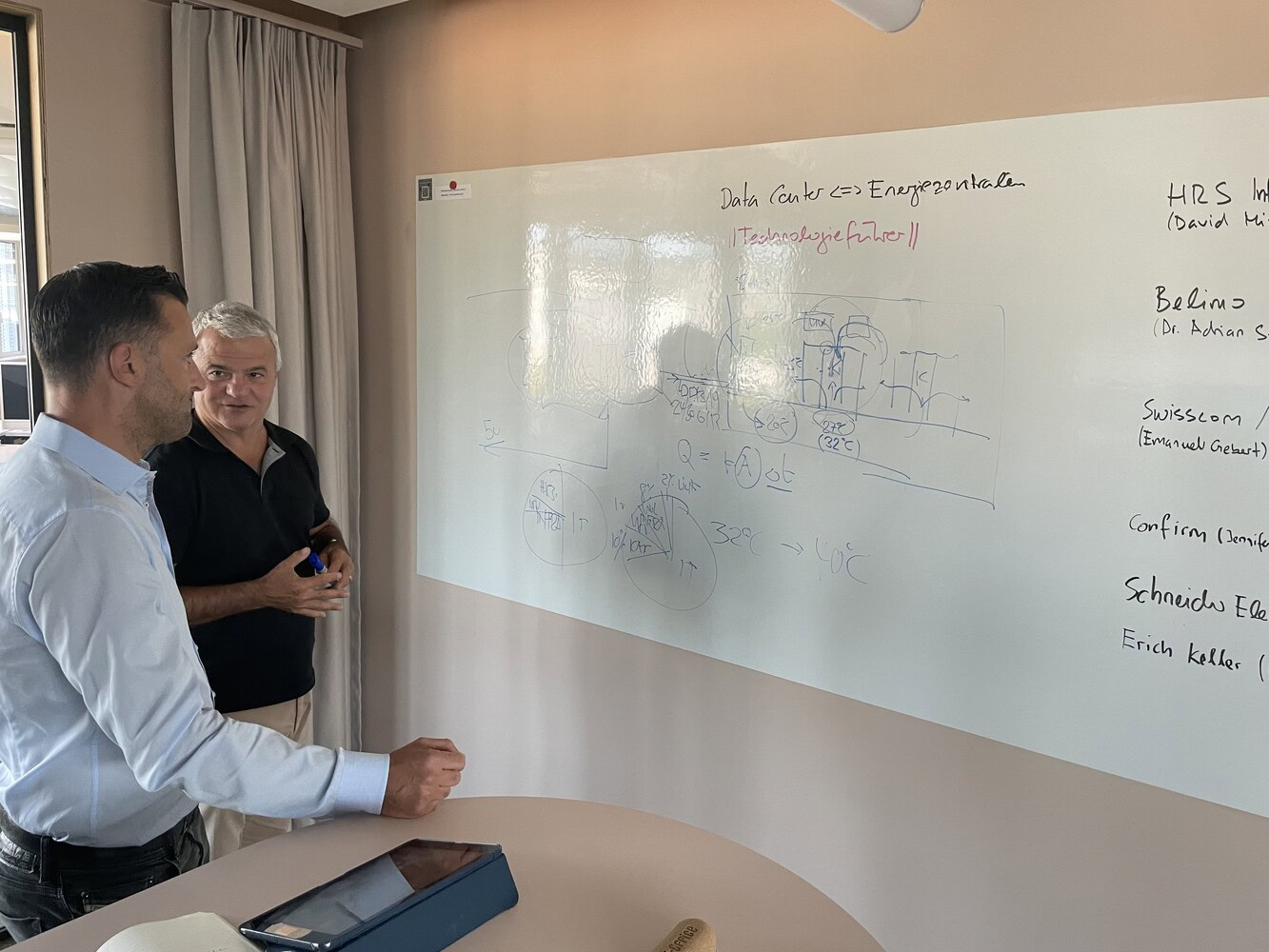
In this expert talk, Prof. Adrian Altenburger and Michael Reuteler discuss energy efficiency, the challenges and potential of data centers and how we can achieve the most energy-efficient digitalization possible.
In Switzerland, we are not doing so badly in an international comparison. Nevertheless, according to the study we were allowed to carry out two years ago, we have around 46 % of efficiency potential in existing centers. This is a key part of the energy issue in Switzerland.
New buildings are being built more efficiently than perhaps 10 or 20 years ago. But of course the potential is far from exhausted. Here, too, we can probably save another 20 % on the thermodynamic or electrotechnical side.
The fascinating thing for me is that it is actually one of the few use cases that is scalable worldwide. It's a topic that doesn't just take place here, but really represents a global development and where I, as an engineer, can make a significant contribution to the quality of such data centers.
The biggest challenge is certainly the tight schedule, which must be adhered to at all costs. In order to meet the deadline, parallel and multi-track construction is taking place everywhere. The plans arrive on site and work starts immediately. The building and the entire infrastructure must be completed within a year.
In my view, the various responsibilities and many technical interfaces within the project organization represent the second major challenge.
Due to the very tight schedule, fast and correct planning and execution without many changes are crucial. This is certainly one of the biggest differences to traditional building construction, where development and changes are sometimes made well into the execution phase. Execution is coordinated in an agile manner using the lean method.
It is also a peculiarity of this sector that both the planning and the realization have an industrial character. There are far fewer requests or adjustments during planning or even during implementation in this area. This is not a disadvantage, but simply the character of data centers, which have more of a functional raison d'être and not necessarily an architectural one.
The use of waste heat within the office space of data centers has been known for some time, but making the heat available to the outside world was not an issue for a long time because the potential customers were not capable of low temperatures.
It is remarkable that we consume gigawatt hours of electricity, almost all of which is converted into heat, and that nothing is done with this heat.
It is now the case that new and renovated buildings are energetically very close to the temperature level generated by a data center and that this waste heat can also be harnessed. We generally have a task of transforming the building stock to CO₂-free operation.
This is an issue that is now increasingly coming to the fore. That doesn't mean it's easy. In terms of spatial planning, too, it must ideally be a place where this waste heat can also be used. It is no use if I can make it available but there is no consumer for miles around.
And it needs relatively large consumers or customers.
Ideally even all year round, as the waste heat is not only generated in winter. The ideal constellation would be, for example, a data center next to a vertical farm, where we are also active with Willers, or in industrial processes.
Certainly. This topic has been approached since the 1980s and people naturally like to be on the safe side, precisely because operational availability is very important in data centers. It took a lot of groundwork/research to find out what the temperature level is and how far we can go. We need system temperatures that are as high as possible in energy terms so that cooling can take place without mechanical refrigeration. The service life of IT equipment is not impaired even with air inlet temperatures >27 °C at the server.
There were already international studies on this in the 1990s, until finally in 2003 the American association ASHRAE a first standard was defined, incidentally in cooperation with the IT industry.
At the time, this already allowed the 27 degree supply air temperature as an entry point into the IT equipment. But 20 years later, it has still not become established because people are still living in these old habits.
Investment is less important than the implementation date, but the energy cost issue is relevant in long-term operation. Of course, it helps if higher temperatures are permitted in order to be able to provide this heat sink with less effort by means of free cooling.

If the supply air temperatures in the data halls were increased to the maximum specifications and the chillers could be dispensed with as a result, the roof area would naturally lend itself to the installation of large-scale photovoltaic systems. As we know, the electricity requirement is very high. I see great potential here to implement this on a larger scale (e.g. on facades).
DC concepts are also exciting, with which conversion losses in the various AC-DC converters from the supply transformers to the servers of up to 10 % could be saved.
I see our contribution in the state-of-the-art approach. That we make the most of what is technically possible in terms of energy and resource conservation and are guided by the advanced state of the art rather than implementing 08/15. In this way, we can help to optimize and minimize not only operating costs and the issue of resources, but also investments. If I don't need a chiller because I can cool at a higher level, then I save on the investment for the chiller, which would also require significantly more electricity in operation than free cooling. This win-win situation is actually self-explanatory, but not necessarily immediately comprehensible to everyone. That's why we are needed as system engineers. We have to take a holistic approach, both conceptually and in terms of implementation, to ensure highly efficient and high-quality operation that not only works, but is as efficient as possible.
Speaker
Since 2015 he has been head of the HSLU Lucerne University of Applied Sciences and Arts the Bachelor's and Master's degree courses in Building Technologies and the Institute for Building Technology and Energy. He has also been advancing our industry for many years in various association activities. Adrian Altenburger has been a member of the Willers Board of Directors since 2017 and Chairman of the Board of Directors since 2022. From 2009 to the present, he has been Vice President of the SIA (Swiss Society of Engineers and Architects) and has been President of the SNV (Swiss Association for Standardization) since 2021.
After graduating as an electrical engineer, Michi started his career in the development department at Tecan. His move to Amstein + Walthert in 2010 marked his entry into building technology engineering. This was followed by exciting management roles at major engineering service providers and a variety of overall project management tasks in building technology.
With an MBA and a CAS in integrated building technology under his belt, Michi joined our team as Zurich site manager in 2021. His focus is on overall management mandates for complex building technology projects. He is currently involved in a large new data center construction in the Zurich region.