Technology
Sustainability

Refrigerants in building technology - sustainable alternatives

Refrigerants play a central role in building technology, particularly in air conditioning, heat pumps and cooling systems. Although synthetic refrigerants have been continuously optimized and their use is still permitted and widespread, we largely advise against their use and recommend using natural refrigerants.
Synthetic refrigerants have been continuously optimized, but their use remains harmful to the environment.
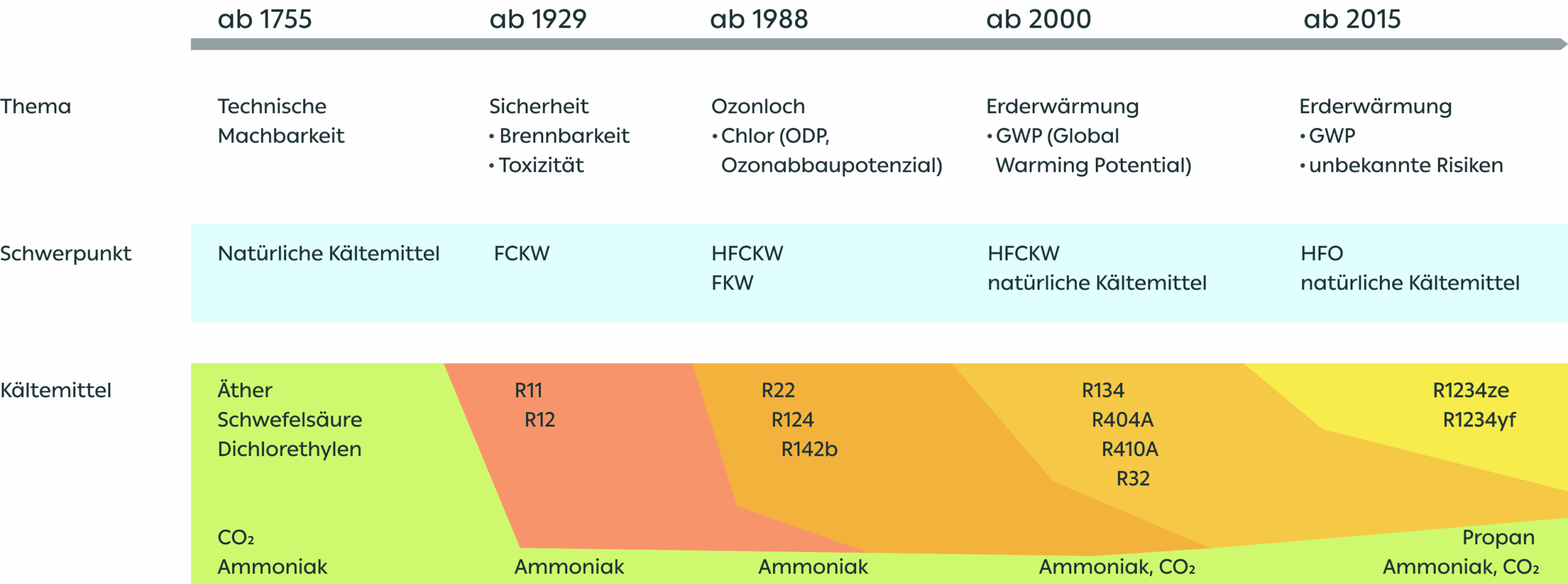
Graphic historical development: synthetic agents still widely used
Historical development of refrigerants: Synthetic agents are still widely used.

Ozone layer as a critical issue

From 1929, synthetic refrigerants replaced natural refrigerants for the first time for safety reasons: lower flammability and toxicity. These refrigerants were chlorofluorocarbons (CFCs). However, their ozone-depleting effect soon became apparent and their use was banned under the Montreal Protocol from 1988.

Global warming as a critical issue

Partially halogenated CFCs (HCFCs) and hydrofluorocarbons (HFCs) were now being used, which contained much less chlorine or none at all and therefore had less impact on the ozone layer. However, it soon became apparent that these new refrigerants were powerful greenhouse gases and therefore contributed to global warming.

From 2000, these refrigerants were replaced by chlorine-free hydrofluorocarbons (HFCs) and natural refrigerants came back into focus due to their negative impact on the climate. However, HFCs are still in use today despite their high global warming potential (up to 14,800 times greater than CO₂). The following applies to the most climate-damaging refrigerants in this group with GWP>2500:
Refilling of systems only with regenerated refrigerant.
Refilling will be prohibited from January 1, 2030.

Eternal chemicals: little researched, but certainly dangerous

The latest generation of synthetic refrigerants, hydrofluoroolefin (HFO) refrigerants, will be in use from 2015. They do not damage the ozone layer and have a comparatively low global warming potential. However, they produce the decomposition product trifluoroacetic acid (TFA). This is one of the per- and polyfluoroalkyl substances (PFAS), i.e. man-made substances that are not degradable in the environment, so-called perpetual chemicals. They can already be detected everywhere in nature and therefore also in drinking water. They have not yet been researched enough, but many scientists agree that they pose relevant problems for the environment and health as their concentration increases.
For HFO refrigerants (GWP < 10, ODP 0) there are currently no planned bans.

Arrangement & outlook

The development of refrigerants shows: Each generation solves a problem - and brings with it new issues. In addition to efficiency and safety, the focus today is primarily on climate impact, environmental persistence and regulatory risks. Choosing the right refrigerant is therefore a strategic decision with long-term effects on operation, investment security and sustainability.

Overview

Refrigerants for large systems - we recommend the use of natural alternatives

Synthetic refrigerants
HFO R1234: ODP0, GWP <1
Class A2L: low toxicity, low flammability

This refrigerant is the synthetic successor to the refrigerant R134a, which is no longer approved due to its GWP 1430.

  • Advantage: low toxicity
  • Ecological disadvantage: Degradation product when released into the atmosphere: poorly degradable trifluoroacetic acid.

    Widely used in refrigeration technology, but due to its „low flammability“ it places the same high demands on the installation site as ammonia in terms of explosion protection.
Natural refrigerants
Ammonia - NH3 R717: GWP 0
Class B2L: highly toxic, flame retardant

This refrigerant has been used frequently for years and has become the standard, particularly for large systems > 500 kW. With the appropriate care, these systems can also be operated safely.

What does highly toxic mean?

  • 25 ppm: typical odor easily perceptible.
  • > 100 ppm: strong odor, may cause panic
  • > 400-700 ppm: immediate irritation of eyes and respiratory tract, but no injury within 30 minutes.
  • > 1700 ppm: injury, acute medical care required
  • > 7000 ppm: unconsciousness, respiratory distress, fatal in minutes (ppm = parts per million)
Natural refrigerants
CO₂ R744: GWP: 1
Class A1: low toxic, non-flammable
Refrigerant limited suitable for high cooling capacity, would require many individual compressors due to high pressures.
Propane R290
Refrigerant with limited suitability for high cooling capacity, especially due to its high flammability and the need for an intermediate circuit in the cooling water.
Water R718, GWP O
Best ecological properties can only be used in small capacities and at significantly higher temperatures than 6/12 °C.
How can we help you
support?
Andreas Rieben
Chief Technology Officer